I used to collect goals the way some people collect notebooks: enthusiastically, and without ever using them. Every January brought a fresh list. Learn a language. Save money. Read twenty books. Get fit. Every December brought the same quiet realisation that most of the list had never really started.
The goals were not the problem. The collecting was.
A quick note on honesty: this page contains affiliate links. If you buy through them, I may earn a small commission at no extra cost to you. The full policy is in the affiliate disclosure.
Learning how to finish your goals starts with making the round smaller: three goals, twelve weeks, one page. Each goal gets three lines — the result you want, the smallest weekly action that moves it forward, and one number you check every Sunday. The weekly action is deliberately tiny (twenty minutes, three times a week) so it survives a bad week. And the page goes on the wall, where you see it every morning — because a goal you see daily stops being a memory and becomes a presence.
A list is not a plan
A list feels like progress. Writing "learn Spanish" in a notebook gives a small hit of satisfaction, almost as if the learning had already begun. But a list only records intentions. It does not decide when the work happens, how much of it happens, or what gets dropped when the week gets busy. And busy weeks always come.
So the list grows, the days stay the same, and by March the goals have quietly become decorations — nice to look at, easy to ignore. That was my pattern for years: big lists, small follow-through, and a fresh list every January to cover the disappointment.
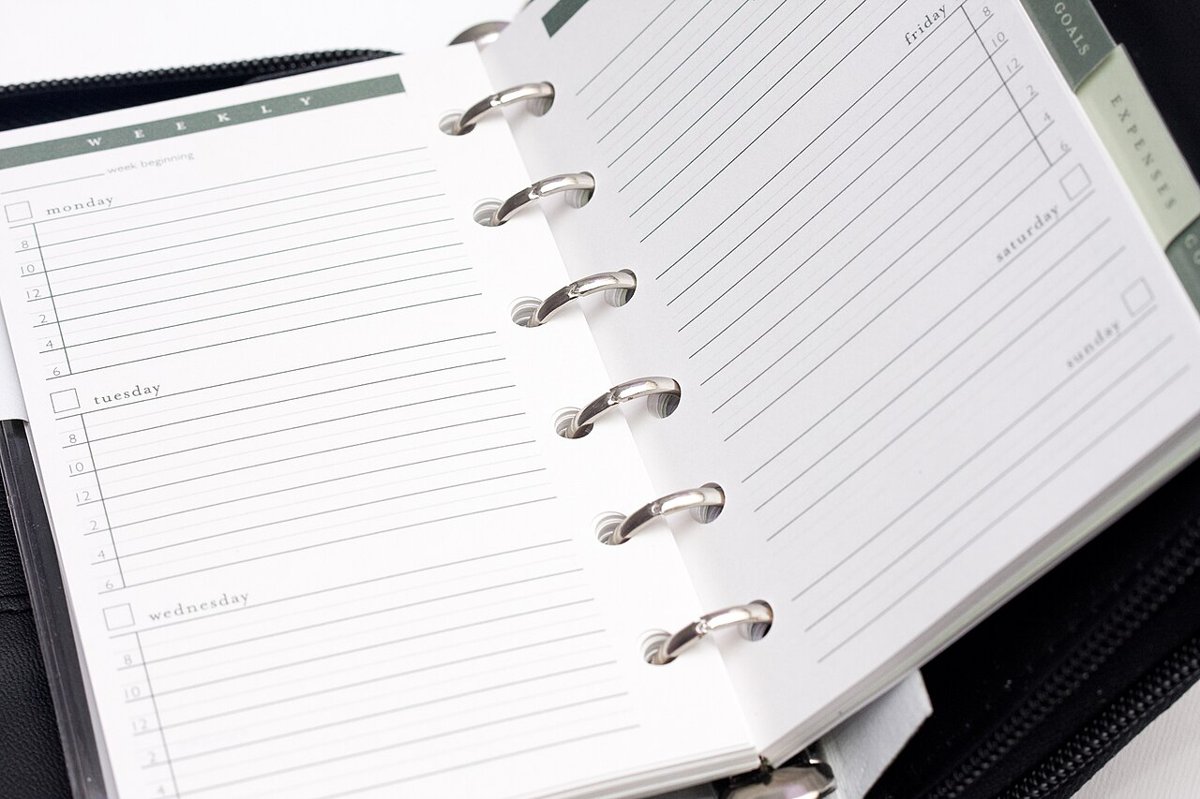
Three goals, twelve weeks
The change was not a new app or a new notebook. It was a smaller horizon. Instead of a year, I started working in twelve-week rounds. Twelve weeks is short enough to feel urgent and long enough to finish something real. You can learn the basics of a language, save a meaningful amount, or build a habit that actually sticks.
And I limited myself to three goals per round. Never more. Three goals fit on one page, and one page fits on a wall. Five goals fit in a drawer, where they are forgotten. The limit is the point: when everything is a priority, nothing is.
Each goal gets three lines underneath it: the result I want, the smallest weekly action that moves it forward, and one number I will check every Sunday. That is the whole plan. No colour coding, no elaborate system. Three goals, three lines each, one page.
The action has to survive a bad week
Most plans fail on the first bad week, so I build the plan for bad weeks from the start. The weekly action is deliberately small: twenty minutes, three times a week. Not an hour a day. Not every morning at 5 a.m. Twenty minutes, three times a week, is twelve hours of real work on one goal over twelve weeks — enough to finish a short course or change a habit for good.
More importantly, I can still do twenty minutes in a week when I am ill, travelling, or working late. A plan that only works in good weeks is not a plan. It is a wish with a timetable.
One number, once a week
Every goal needs a number. Feelings are too easy to argue with. So each Sunday I check one number per goal: money saved, sessions done, pages read. Five minutes, three numbers, written on the same page.
If a number moved, the system is working and I keep going. If it did not move for two weeks, I do not blame myself — I change the action. Maybe twenty minutes is still too much, or the wrong time of day. The goal stays. The method changes. That distinction matters: quitting a method is not the same as quitting a goal.

Put the page on the wall
The last piece sounds too simple to matter, and it mattered most. I put the page on the wall beside my desk, at eye level, where I see it every morning. Not in a notebook. Not in an app. On the wall.
A goal you see every day stops being a memory and becomes a presence. On a tired evening, the page is still there, quietly asking whether the small action happened today. I no longer need willpower to remember my goals. The wall remembers them for me.
That is also why the three-goal limit works. A wall has limited space, and that is a feature. When a new idea arrives in week six, it waits for the next round. The page protects my attention from my own enthusiasm.
What changed
After four twelve-week rounds — a full year, in smaller pieces — the results were not dramatic in any single week. Added up, they were. I finished things I had started and abandoned for years: a course, a savings target, a reading habit. Not because I tried harder, but because the system removed the two things that used to stop me: goals I could forget, and plans that broke at the first bad week.
If your lists keep fading by March, try a smaller round. Pick three goals. Give them twelve weeks. Write the smallest weekly action under each one, choose one number to check every Sunday, and put the page on the wall where you will see it tomorrow morning. Then let the weeks do the work.
A worked example: three goals on one page
The method is easier to trust once you see it filled in. Here is what one page could look like for a twelve-week round starting now — steal the shape, change the goals to yours:
- Goal 1 — Save $300. Result: $300 set aside by week twelve. Weekly action: move $25 into savings every Monday morning, before anything else. Sunday number: total saved so far.
- Goal 2 — Read 6 books. Result: six books finished, one every two weeks. Weekly action: read for twenty minutes, three evenings a week. Sunday number: pages read this week.
- Goal 3 — Walk more. Result: walking three times a week, every week, without a break. Weekly action: a thirty-minute walk on Monday, Wednesday and Saturday. Sunday number: walks done this week (out of three).
Notice what is missing: no 5 a.m. alarms, no hour-long sessions, no fourth goal sneaking in. If a week goes badly, the smallest version still counts — ten minutes of reading is still reading, one walk is still a walk. The round is won in the bad weeks, not the good ones. And if a number stalls for two Sundays in a row, change the action, not the goal: read at lunch instead of at night, walk after dinner instead of before work.
Turn your three goals into a vision board
The page on the wall and the vision board on the wall are the same idea in two forms: something you see every day, quietly asking whether the small action happened. So once your three goals are chosen, give each one a picture.
Pick one image per goal — the savings jar, the bookshelf, the morning walk — and add them to your 2027 board beside the words that describe how finishing will feel. My step-by-step vision board guide shows the order that works: goals first, images second, plan always. If you want the quarterly rhythm behind the twelve-week rounds, the 2027 quarterly plan breaks the same idea into four milestones per goal and a twenty-minute monthly check-in.
Two of my own books sit beside this system. The 2027 Reset Planner holds the practical half — monthly calendars, habit and money trackers and quarterly resets, so the small weekly actions have somewhere to live (140 pages, paperback, $19.99). And 365 Journaling Prompts gives you one gentle prompt for every day of 2027 — five quiet minutes each morning, and a good place to record the Sunday numbers (382 pages, paperback, $19.99). Both live permanently on the Shop page. Or start free with the 2027 Vision Board Starter Pack — it is the fastest way to get your three goals onto a board tonight.
How to finish your goals — FAQ
Is three goals really enough?
For twelve weeks, yes — and that is the point. Three goals fit on one page and in one week. A fourth goal does not add ambition, it adds a drawer to hide things in. Anything else you want can wait for the next round; twelve weeks pass faster than you think.
What if I miss a whole week?
Then the round is not ruined — it is doing its job. A missed week is information, not failure: the action was probably too big, or scheduled at the wrong time. Shrink it (ten minutes instead of twenty, one walk instead of three) and restart the same week. Never try to "catch up" by doubling — that is how plans break for good.
Does this work with a vision board?
Yes — they are built for each other. The board shows you the feeling of the finished goal every morning; the page tells you the smallest action for today. Put them side by side on the same wall and they do the remembering together.
When should I start a twelve-week round?
On the next Monday, not the next January. A round that starts this Monday finishes before the season changes — and four rounds make a full year. If you are reading this in November, your first round can end in February, right when the January rush has faded and most people have quietly quit.
Collecting goals vs finishing them
The old way and the finishing system, side by side:
| Collecting | Finishing | |
|---|---|---|
| Goals at once | 10–15, saved everywhere | 3, on one page |
| Timeframe | The whole year, vaguely | 12 weeks, with an end date |
| Tracking | Saved posts and good intentions | One page on the wall |
| A bad week | The plan quietly collapses | The system expects it — shrink and restart |
| The result | A busy feeling | Finished goals |